
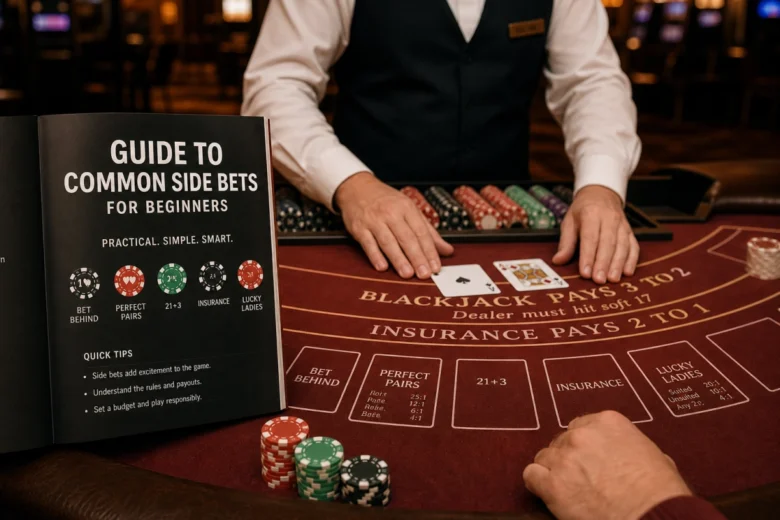
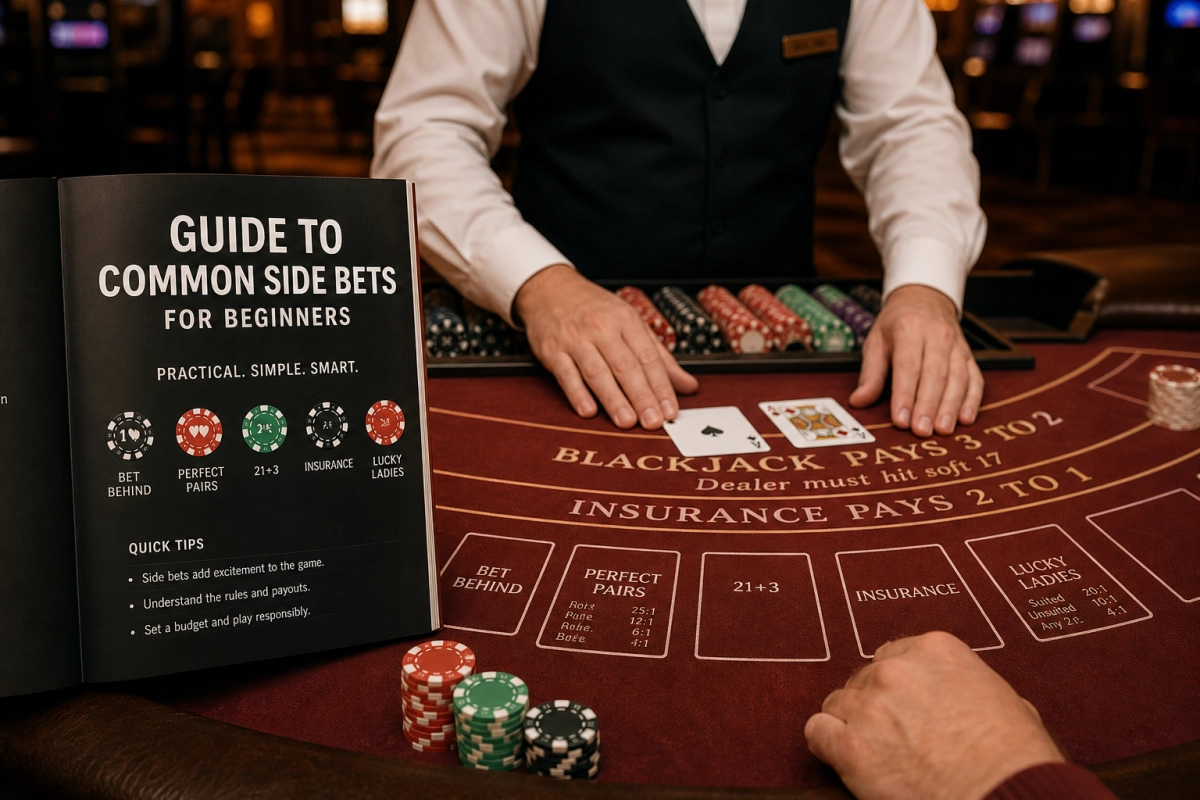
Common side bets on table games: what they are and why they matter
Side bets are optional wagers offered alongside the main game on many table games. This guide explains common side bets on table games such as blackjack, baccarat, roulette and craps. Readers will learn how each side bet works, see typical paytables and payout math (odds, RTP and house edge), understand the likely impact on a bankroll, and get clear, practical rules for when a small wager makes sense and when a side bet should be ignored.
How table-game side bets are structured and how to read the math
Side bets are resolved independently from the main bet and usually pay fixed odds when specific events occur (pairs, suited combinations, particular rolls, etc.). Because the payout is fixed while the true probability of the event varies by deck/wheel size, side bets almost always carry a higher house edge than the base game.
Key terms in plain language
- RTP (Return to Player): The theoretical percentage of wagers returned to players over the long run (RTP = 100% − house edge).
- House edge: The casino’s long-term advantage, expressed as the average percentage of each bet the casino keeps.
- Paytable: The list of payouts for winning combinations on the side bet (e.g., Perfect Pair pays 25:1 for exact suited pair).
Simple math example (roulette straight-up)
European roulette has 37 numbers (0–36). A straight-up number pays 35:1. Probability = 1/37. Expected value per $1 bet = (1/37 × $35) + (36/37 × −$1) = −$0.0270, so house edge ≈ 2.70% and RTP ≈ 97.30%. This calculation model — payout × probability − loss × probability — is the same used for side bets.
Quick, typical paytables and house-edge ranges (examples)
The table below lists common side bets, typical payouts and approximate house-edge ranges to give beginners a feel for how costly these bets are over time.
| Game / Side bet | Typical payout (example) | Approx. house edge | Approx. RTP |
|---|---|---|---|
| Blackjack — Insurance | Pays 2:1 if dealer has blackjack | ~7% (varies by deck) | ~93% |
| Blackjack — Perfect Pairs | Mixed 5:1, Coloured 10:1, Perfect 25:1 (typical) | ~4–11% | ~89–96% |
| Blackjack — 21+3 | Flush 5:1, Straight 10:1, Trips 30:1, Suited Trips 100:1 (varies) | ~3–4% | ~96–97% |
| Baccarat — Player/Banker Pair | Pays 11:1 (typical) | ~10.3% | ~89.7% |
| Baccarat — Tie | Pays 8:1 (common) | ~14.4% | ~85.6% |
| Craps — Hardways | Hard 6/8 pays 9:1, Hard 4/10 pays 7:1 | ~9–11% | ~89–91% |
| Craps — Any 7 | Pays 4:1 | ~16.7% | ~83.3% |
Note: paytables and house edges vary by casino and by deck/wheel configuration. The numbers above are typical examples, not guarantees.
Practical bankroll guidance and when to place a side bet
- Rule of thumb: keep side bets small — generally under 5% of your session bankroll or main wager. Side bets have higher variance and higher house edge.
- Play side bets for entertainment value (bigger payouts and excitement) rather than as a long-term profit strategy.
- Avoid side bets if protecting your bankroll is the priority; they erode expected value faster than the base game.
The next section breaks down blackjack and baccarat side bets in detail, showing explicit paytables, step‑by‑step RTP calculations and clear scenarios when each bet is reasonable versus when it should be skipped.
Final practical examples — bankroll impact and sample wagers
Example 1: small-session leisure play
Session bankroll: $200. Main bet: $10 blackjack hands. Practical side-bet limit (≤5% of session): $10 or ≤10% of main bet: $1–$2.
- If you place a $1 side bet with a 10% house edge, expected loss per bet = $0.10. Over 100 side-bet rounds that’s ≈$10 expected loss.
- If the side bet instead has a 4% house edge, expected loss per $1 bet = $0.04; 100 rounds ≈$4 expected loss. That difference matters over many hands.
- Takeaway: keeping side bets at $1–$2 preserves playtime and limits expected erosion of the bankroll.
Example 2: higher-stakes session
Session bankroll: $2,000. Main bet: $100 baccarat Banker/Player. Practical side-bet limit (≤5% of session): $100, but relative to main bet a safer cap is 1–2% ($1–$2 per $100) to avoid large variance.
- A $5 side bet at 14% house edge (e.g., many Tie bets) has expected loss = $0.70 per resolution. Over 50 plays that’s ≈$35 expected loss — significant relative to entertainment value.
- If you want occasional thrills, a single larger side bet can be fine as an entertainment spend, but don’t make it a repeating strategy or bankroll will shrink rapidly.
Quick decision checklist before you bet a side wager
- Check the paytable — small differences change RTP materially.
- Limit side-bet size to a tiny fraction of bankroll (1–5%), or to a predictable entertainment budget per session.
- Ask whether you value volatility and big-jackpot moments more than preserving expected return; if not, skip the side bet.
- Avoid repeating high-house-edge side bets many times; a single speculative wager for fun is less costly than dozens of repeated plays.
Parting notes for smart, entertained wagering
Side bets are designed to be fun and dramatic — not to be your path to profit. If you enjoy the added excitement and can accept the likely additional expense, place small, deliberate wagers and treat them as entertainment. If preserving your bankroll or maximizing long-term return matters more, fold on most side bets and focus on the base game where skill and strategy (where applicable) make a difference.
Always read the paytable, control bet size relative to your session bankroll, and stop when the fun stops. That balance — modest wagers for enjoyment without risking the session — is the best practical rule for beginners and experienced players alike.
Extra guidance: misconceptions, promos and progressive side bets
There are a few common misconceptions worth addressing. First, a flashy payout advertised on a sign does not automatically mean good value; side bets are marketing tools designed to create excitement and occasional big wins, and most carry a substantially higher house edge than the base game. Second, casino promotions (free-play credits, matched bets, or temporary paytable boosts) can temporarily improve the expected value of a side bet — if you receive a free wager you might rationally play a higher-house-edge side bet for entertainment since the marginal cost is zero, but treat promotional value separately from underlying game math.
Progressive side bets deserve special mention. Some progressive pools can, at particular jackpot sizes, produce a positive expectation for a single wager if the jackpot is large enough to offset the poor base paytable. However, the jackpot must be unusually large; most of the time progressives still represent negative EV and high variance. If you consider playing a progressive side bet, check the current jackpot and calculate the break-even amount before committing repeated bankroll to it.
How to calculate RTP/EV yourself — simple steps
- Step 1: list every possible winning outcome on the paytable and the payout for each (e.g., 25:1, 10:1, 5:1).
- Step 2: determine or estimate the probability of each outcome (this depends on deck count, number of dice, or wheel slots).
- Step 3: compute expected value (EV) per unit bet = sum over outcomes (probability × payout) + probability of losing × (−1). For a $1 bet, this yields EV in dollars; RTP = (EV + 1) × 100%.
- Step 4: convert EV to house edge = 100% − RTP.
These steps are the same arithmetic used earlier for roulette but applied to the more complex paytables of side bets. If you do not want to calculate probabilities from first principles, look for published RTP calculations for the specific paytable and game variant.
Managing variance: practical rules
- Use a fixed, small unit for side bets and resist increasing the size after a loss (don’t chase).
- Set both a session loss limit and a profit-taking threshold to lock in entertainment value without giving the house more time to erode your bankroll.
- Try side bets in free-play or low-stakes formats first to learn the rhythm and volatility before staking real money.
- Record outcomes for a session if you want a realistic sense of typical streaks and drawdown; variance can feel much worse than the average EV suggests.
In short: treat side bets as optional entertainment with quantifiable costs. Use the simple EV/RTP method above to make informed choices, leverage promotions where logical, and keep bet sizes strictly controlled so the fun lasts without a disproportionate hit to your bankroll.