

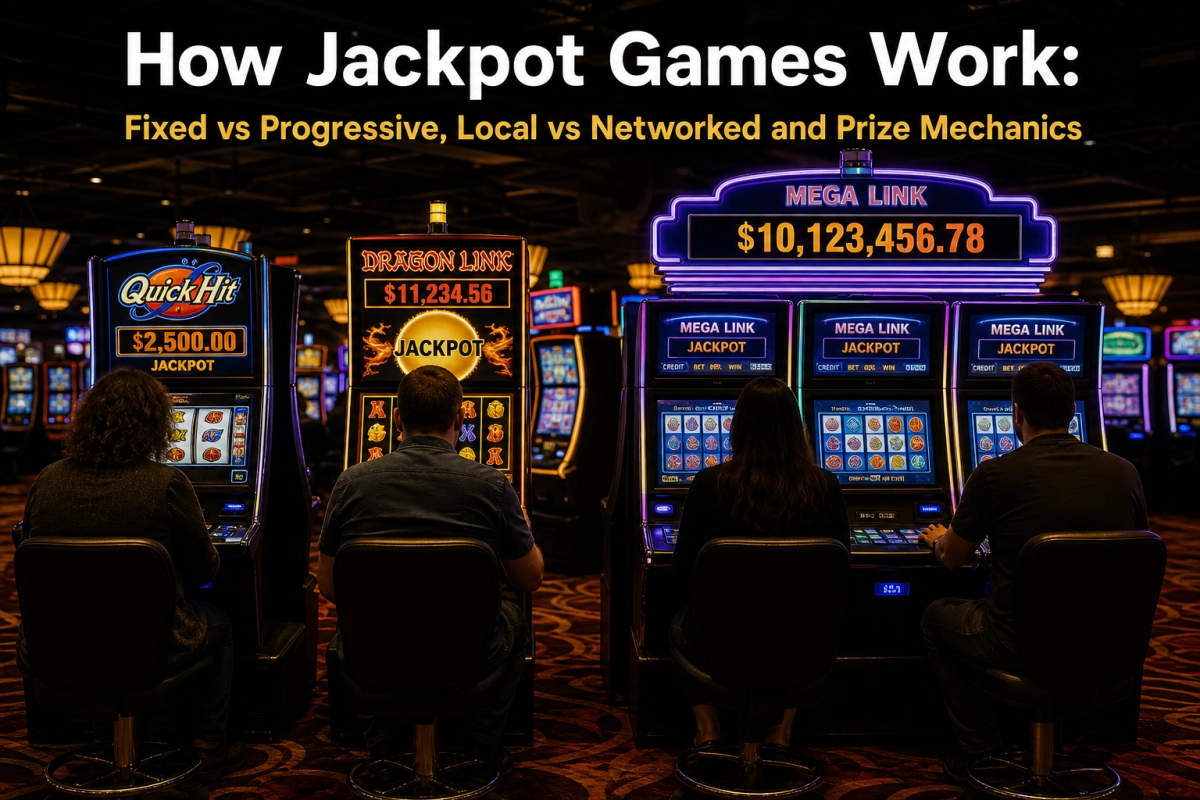
How jackpot games work: simple explanations for fixed and progressive jackpots
Jackpot games are casino games that offer unusually large top prizes. This guide explains the core mechanics players need to understand: the difference between fixed and progressive jackpots, local versus networked progressives, how contribution rates and seed amounts create the prize pool, and basic payout mechanics. Readers will learn practical implications for odds, RTP (return to player) and bankroll planning so they can evaluate offers responsibly.
Fixed jackpots versus progressive jackpots — what changes for the player
Fixed jackpots pay a constant top prize that does not grow. Progressive jackpots increase over time as players make qualifying bets. Both can appear in slot machines, video poker, and some table-game side bets, but they behave differently for odds and value.
| Feature | Fixed jackpot | Progressive jackpot |
|---|---|---|
| Top prize | Set amount (e.g., 1,000 coins) | Grows with contributions (can reach millions) |
| RTP impact | Included in house edge/RTP calculations | Partial RTP diverted to jackpot; base game RTP is lower |
| Odds | Static, determined by paytable and hit frequency | Rare and variable; payout depends on pool size |
Practical example
On a fixed-jackpot slot, a three-of-a-kind top win might be 5,000 credits every time it hits. In a progressive, the equivalent hit might pay whatever the progressive has accumulated — more attractive when the pool is large but statistically rarer and with a lower base RTP.
Local versus networked progressive jackpots and how the pool grows
Progressives are often classified as local or networked:
- Local progressives pool contributions from machines in the same venue or linked cluster. Jackpots tend to grow more slowly and hit more frequently.
- Networked progressives combine contributions from many casinos or many machines across an operator’s network. These reach much larger values but the chance of any one player winning stays small.
Two main components build a progressive jackpot:
- Seed — the starting amount the game operator or casino sets (sometimes guaranteed minimum).
- Contributions — a small percentage of each qualifying bet that is diverted into the jackpot pool.
Typical contribution rates vary by game — often 0.1% to 3% of a bet — and are reflected in the advertised RTP or in the game’s terms. For example, if a slot diverts 1% of every wager to the progressive, that 1% reduces the effective RTP available through regular payouts.
Payout mechanics and common caps
When a progressive hits, the operator pays the listed jackpot amount. Casinos may impose rules such as:
- Minimum qualifying bet to be eligible for the progressive.
- Maximum single-payout caps or alternative installment payments for huge wins.
- Tax reporting and identity verification requirements for large payouts.
Understanding these eligibility and payout rules is essential before playing. The next section will explain realistic odds, RTP implications, volatility and practical bankroll strategies for jackpot games.
Realistic odds, RTP implications and how to think about value
Progressive jackpots change the math behind every spin. Two practical points to keep in mind:
– RTP and diversion: the portion of each bet diverted to a progressive (the contribution rate) reduces the base-game RTP available through normal payouts. If a slot’s advertised RTP is 95% but 1% of wagers go to a progressive pool, the effective RTP for base prizes is closer to 94%. That reduction is how the casino funds the growing jackpot and is already built into the game design or terms.
– Expected value and hit frequency: a jackpot’s headline size does not by itself make a bet +EV. Expected value (EV) for a qualifying wager is roughly probability of hitting × jackpot minus the house edge on the non-jackpot part. Because the probability of triggering a progressive top prize is extremely small (often a fraction of a percent or much lower per spin), most play remains negative-EV even when the jackpot looks huge. A progressive only becomes mathematically attractive when the pool is so large that the jackpot × hit-probability outweighs the lost RTP — a rare situation and often quickly corrected by increased play as players queue in.
Practical example: if the chance to hit the progressive is 1 in 1,000,000 per spin and the jackpot is $500,000, the raw expected jackpot return per spin is $0.50. If your average bet is $1 and the non-jackpot RTP implies a loss of $0.05 per spin, the combined EV is still negative once house edge and variance are factored in. In short: big numbers are exciting, but odds and contribution mechanics determine real value.
Volatility, bankroll strategies and sensible betting rules
Jackpots increase variance: they create low-probability, high-payout outcomes that dramatically widen a game’s volatility. That changes the bankroll approach:
– Size your bankroll to withstand long losing runs. For high-volatility progressive machines, plan for more spins between wins; a common conservative rule is to allocate a larger number of bets per session (hundreds to thousands of basic wagers) than you would for a low-volatility slot.
– Match bet size to qualification rules. Many jackpots require a minimum or maximum bet (often “max bet to qualify”). Don’t risk a bankroll-crushing max bet unless that stake fits your loss limits. If the machine requires $1 per spin to qualify but you can only sustainably afford $0.10 x 10 spins, the chance of hitting while staying within budget is very small.
– Play within target session lengths and stop-loss/win targets. Set loss limits (e.g., stop after losing X% of your session bankroll) and take-profit points. Avoid the gambler’s fallacy — each spin is independent.
– Prefer local progressives if you want more frequent, smaller hits; choose networked progressives only if you accept very long odds in exchange for a much larger top prize.
How bonuses interact with jackpot play, evaluating jackpot terms, and responsible play
Bonuses and jackpots can clash. Common restrictions include ineligible jackpot play (progressives excluded from bonus wagering), capped jackpot wins from bonus-funded play, and wagering requirements that treat bonus bets differently. Always read the bonus T&Cs: look for language on “progressive jackpots,” “maximum cashout,” and what stake sizes qualify while meeting wagering requirements.
When evaluating a jackpot offer, check:
– Minimum qualifying bet and whether max-bet is required.
– Seed amount and how often contributions are taken.
– Payout format (lump sum vs. annuity) and any caps or tax-related withholdings.
– Whether the jackpot is local or networked and historical hit frequency if available.
Responsible-gambling guidance: treat jackpot play as entertainment, not investment. Set strict bankroll limits, avoid “chasing” losses, don’t borrow to play, and use casino tools (deposit limits, session timers, self-exclusion) if your play becomes risky. The rare life-changing win exists, but the safer approach is controlled play informed by odds and terms rather than chasing headlines.
Practical pre-play checklist
- Confirm the minimum/maximum bet needed to qualify for the jackpot.
- Check the contribution rate or how the jackpot is funded, and whether the game’s advertised RTP reflects that diversion.
- Verify payout rules: lump sum versus annuity, caps, tax reporting and identity verification requirements.
- Read bonus terms carefully to see if progressives are excluded or subject to maximum bonus cashout limits.
- Decide an affordable session bankroll, set stop-loss and take-profit limits, and stick to them.
- Prefer local vs. networked progressives based on whether you want more frequent small wins or long-shot large jackpots.
- If a jackpot looks “too good to be true” mathematically, reassess — large pools don’t change the underlying odds of very rare events.
Final notes for smart jackpot play
Jackpot games can be thrilling, but the best outcomes come from knowing the mechanics, reading the fine print, and managing your play rather than chasing headlines. Treat these games as entertainment: set limits, favor transparency (seed amounts, contribution rates, qualifying stakes), and choose games that fit your tolerance for volatility. If your play ever feels compulsive or exceeds what you can afford, use the casino’s responsible-gambling tools or seek professional help. Play informed, play within limits, and enjoy the experience without risking your financial wellbeing.