
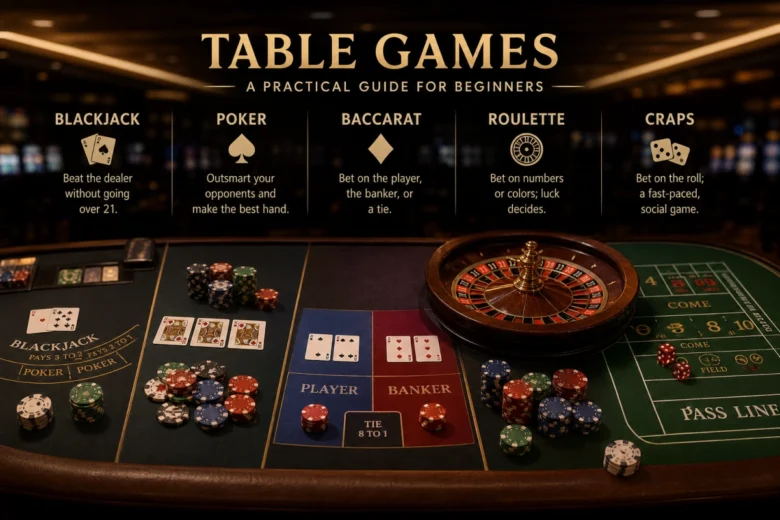
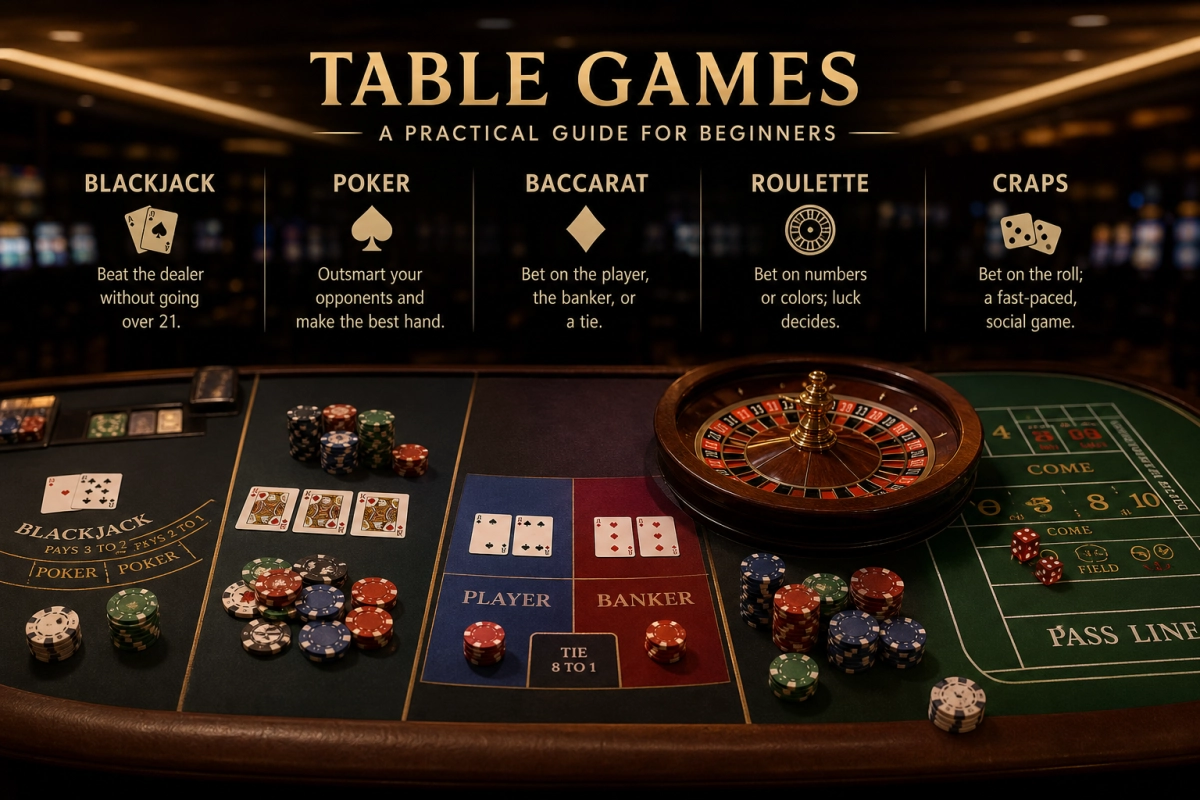
A practical, beginner-friendly guide to popular table games
This guide explains how much skill or luck influences each game, gives simple rules and common bets, summarizes typical house edge/RTP ranges, and offers basic strategy and bankroll guidance for adults of legal gambling age playing in land-based or online casinos.
Who should use this comparison and how it’s organised
Designed for beginners who want reliable, simple rules and for experienced players wanting a concise comparison of mechanics and where skill matters. Each game is covered with basic rules, common bets, typical house edge/RTP, how much skill matters, and straightforward ways to reduce the house edge where possible. Responsible gambling advice—set a budget, use time limits and treat play as entertainment—is woven throughout.
How much skill vs luck affects each table game: a quick comparison
Some games reward decision-making; others are mainly chance. The table below summarises relative skill requirements and typical house edge/RTP ranges for common variants.
| Game | Skill vs luck | Typical house edge / RTP | Short bankroll note |
|---|---|---|---|
| Blackjack | High skill potential (basic strategy reduces edge) | House edge ~0.5% with basic strategy (RTP ~99.5%) | Low volatility; small bets (1–2% of session bankroll) |
| Poker (Hold’em, Omaha) vs Casino poker (3-Card, Caribbean) | Player poker: skill-heavy; casino variants: more luck-based | Player poker: rake varies; casino poker games: ~3–7% house edge | Poker needs many buy-ins; 20+ buy-ins for cash is typical |
| Baccarat | Low skill—bet selection only | Banker ~1.06%, Player ~1.24%, Tie ~14% (avoid) | Straightforward bets; low variance |
| Roulette | Mostly luck—bet choices affect variance | European 2.70% (RTP 97.30%), American 5.26% (RTP 94.74%) | Prefer European wheel; outside bets lower variance |
| Craps | Mixed—pass/don’t pass low edge; prop bets are poor | Pass ~1.41%, Don’t pass ~1.36%; odds bets 0% | Use odds to control house edge |
Practical bankroll and goal-based selection guidance
- Low-risk recreation: choose low-house-edge games (blackjack with basic strategy, baccarat banker, pass line craps) and bet 1–2% of a session bankroll per wager.
- Bigger swings for entertainment: roulette and craps prop bets create excitement; reduce bet size to 0.5–1% if preserving bankroll matters.
- Poker for skill/earning: expect a learning curve; bankroll planning requires many buy-ins (20–100 depending on format).
Blackjack: clear rules, common bets and simple ways to cut the house edge
Objective: beat the dealer without exceeding 21. Players get two cards and may hit, stand, double, split pairs, and sometimes surrender. Dealer rules (hit/stand on soft 17), number of decks, and blackjack payout (3:2 desirable; avoid 6:5) materially affect the house edge.
Common bets and pitfalls
- Main bet: play your hand vs dealer. Insurance is almost always poor value—avoid.
- Splits: split A-A and 8-8; never split 10s. Doubling on 9–11 vs weak dealer upcards is high-value.
- Surrender (when available) trims losses on poor hands; early surrender rare, late surrender helpful.
House edge / practical numbers
With basic strategy and favourable rules (3:2 blackjack, dealer stands on soft 17, double after split allowed) house edge ≈ 0.5% (RTP ≈ 99.5%). Poor rules (multiple decks, dealer hits soft 17, 6:5 payouts) add tenths or multiples of a percent and can make the game unprofitable.
Beginner strategy you can use tonight
- Learn a basic-strategy cheat sheet: hit hard totals ≤8, stand on many 12–16 vs dealer 2–6, double 10 or 11 vs lower dealer cards, split A-A and 8-8, never take insurance.
- Avoid card counting as a beginner—it’s complex, requires a large bankroll and can get you restricted in casinos.
Bankroll and bet sizing
Low volatility—use 1–2% of session bankroll per hand for recreational play. Increase size only after consistent practice with basic strategy and adequate bankroll support.
Poker variants: skill-based Texas Hold’em/Omaha and how casino poker differs
Player-versus-player poker (Hold’em, Omaha) is skill-dominant over time; casino house-banked variants (3-Card Poker, Caribbean Stud, Casino Hold’em) use fixed pay tables and behave like other table games with a house edge.
Hold’em and Omaha basics for beginners
- Hold’em: two hole cards + five community cards. Omaha: four hole cards, must use exactly two.
- Key skills: starting-hand selection, position, bet sizing, reading opponents, and pot odds.
- Simple tips: play tighter from early position, widen in late position, value-bet strong hands, fold when pot odds don’t justify calls. Omaha requires tighter starting ranges due to four cards.
Bankroll guidance for skill play
Cash games: aim for 20–40 buy-ins at your chosen stakes. Tournaments: much higher variance, plan 100+ buy-ins for consistency. Omaha generally needs a larger bankroll than Hold’em.
Casino (house-banked) poker
- 3-Card Poker: Ante/Play house edge ≈ 3–4% with correct basic play; Pair Plus depends on pay table and can be worse.
- Caribbean Stud and Casino Hold’em typically have house edges of 5%+; side bets are usually poor value.
- Treat house-banked poker like other casino games: play small, avoid side bets unless you understand the pay table.
Baccarat — simple play, low decision complexity
Basic rules
Two hands are dealt: Player and Banker. Totals are calculated mod 10 and a fixed third-card table applies. The higher total wins; naturals (8 or 9) end the round early.
Common bets
- Banker: smallest house edge but usually pays a commission on wins.
- Player: slightly higher edge than Banker; pays even money.
- Tie: high payout but very poor value—avoid for long-term play. Side bets also carry larger edges.
House edge / RTP
Typical: Banker ≈ 1.06% (with 5% commission), Player ≈ 1.24%, Tie often ~14% or worse. Side bets generally much higher.
Skill vs luck
Minimal skill—your only decision is which bet to place.
Simple strategy to reduce house edge
- Bet Banker to minimise edge (account for commission).
- Avoid Tie and most side bets.
- Use flat or small consistent stakes to limit variance.
Bankroll guidance
Lower volatility than many table games—use about 1–2% of session bankroll per wager for recreational play.
Roulette — pick the wheel and your tolerance for variance
Basic rules
A wheel with numbered pockets is spun and a ball lands on a number. Bets cover individual numbers (inside) or broader groups (outside) such as red/black, odd/even, dozens and columns.
Common bets
- Inside: Straight (single number), split, street, corner—high payout, high variance.
- Outside: Red/Black, Odd/Even, 1–18/19–36, Dozens, Columns—lower payout, lower variance.
House edge / RTP
European (single zero) ≈ 2.70% house edge (RTP ~97.30%). American (0 and 00) ≈ 5.26% (RTP ~94.74%). French rules with La Partage/En Prison can halve the effective edge on even-money bets to ~1.35%.
Skill vs luck
Almost entirely luck-based—bet selection only changes variance, not long-term EV.
Simple strategy to reduce house edge
- Choose European wheels and games with La Partage/En Prison when available.
- Use even-money outside bets to reduce variance; avoid betting systems that promise to beat the edge.
Bankroll guidance
Inside bets: high variance—use 0.5–1% of session bankroll. Outside bets: can use 1–2% per spin for recreational play.
Craps — use the right bets and add true odds when possible
Basic rules
A shooter rolls two dice. Come-out 7 or 11 wins Pass; 2,3,12 are losses. If a point is set (4,5,6,8,9,10) the shooter must roll it before a 7 for Pass-line wins. Don’t Pass is the opposite. Many follow-up bets are available.
Common bets
- Pass / Don’t Pass and Come / Don’t Come—fundamental, low-edge bets.
- Odds bets—placed behind Pass/Don’t Pass; pay true odds and carry no house edge.
- Place bets and Field—moderate edges; proposition and one-roll bets—high edge, avoid long-term.
House edge / RTP
Pass ≈ 1.41%, Don’t Pass ≈ 1.36%. Odds bets have 0% edge. Proposition bets can be 5%–16% or worse.
Skill vs luck
Dice are random, but disciplined bet selection (use of odds, avoiding prop bets) materially reduces effective house edge.
Simple strategy to reduce house edge
- Play Pass/Don’t Pass or Come/Don’t Come and take full odds where allowed.
- Avoid one-roll proposition bets and high-edge side wagers.
- Size bets conservatively and don’t chase streaks.
Bankroll guidance
Moderate variance—use 1–2% of session bankroll on base bets and size odds relative to your total bankroll and risk tolerance.
Putting choices into practice
Pick one game to learn at a time and focus on the small, controllable things: rules, common bets, and a simple strategy you can follow consistently. Use low-stakes or play-money formats to practice without pressure, track your sessions and limits, and treat gambling as entertainment rather than a way to make money. For games where skill matters (poker, blackjack), commit time to fundamentals before raising stakes. For chance-heavy games (roulette, baccarat, many craps prop bets), prioritise bankroll management and bet selection that match your comfort with swings.
Above all, set clear loss and time limits, never gamble with money you can’t afford to lose, and walk away when the session stops being fun. With a measured approach you’ll enjoy the social and strategic side of table games while keeping long-term risk under control.