
Understanding RTP and risk metrics for online casino games
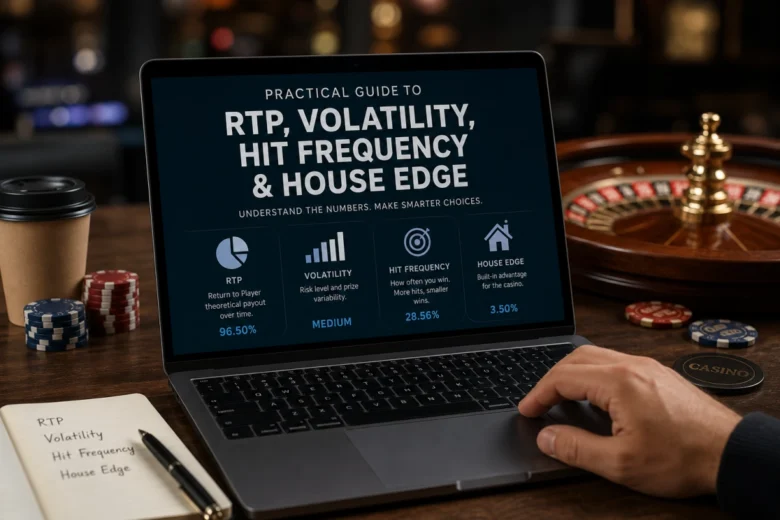
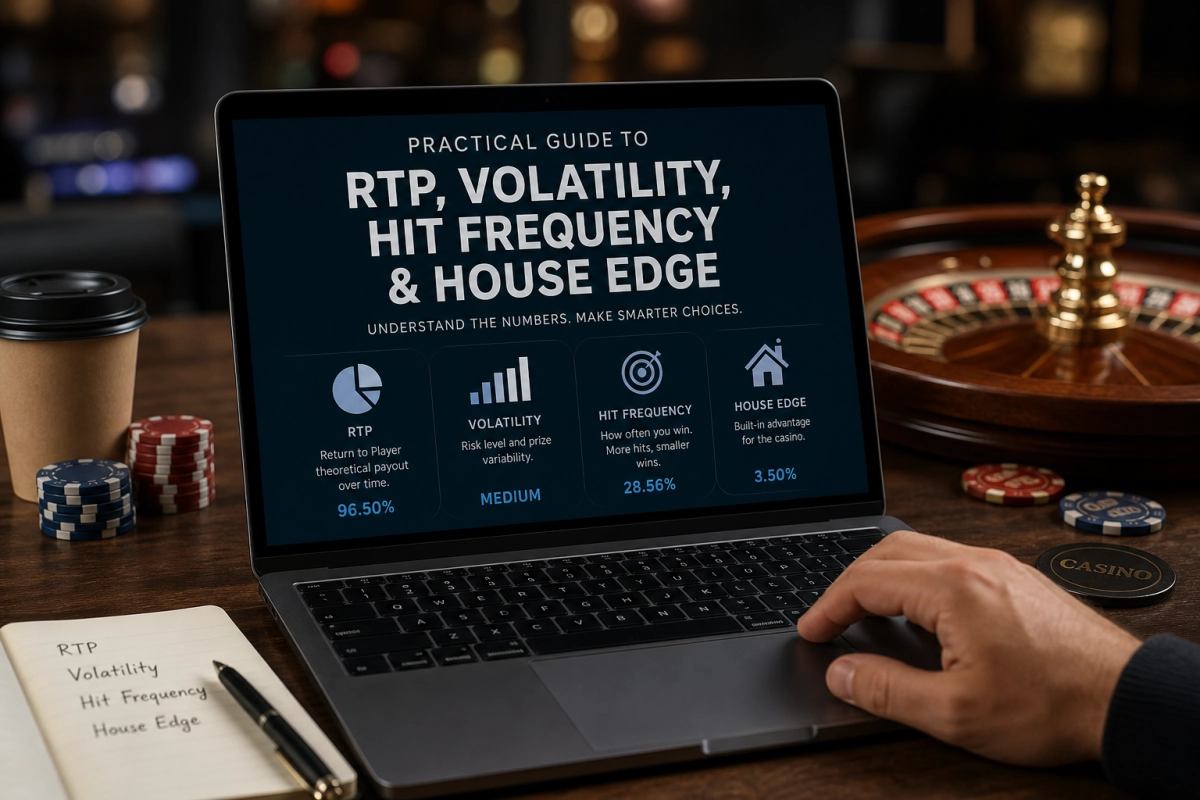
This guide explains the core performance metrics players use to evaluate online casino games: return to player (RTP), volatility (also called variance), hit frequency and house edge. Readers will learn what each term means, how to read and compare numbers for slots, roulette, blackjack, baccarat and video poker, plus simple example calculations that show expected losses and session expectations. The article is written for adults of legal gambling age and treats gambling as entertainment, not a guaranteed income.
How RTP, volatility, hit frequency and house edge differ and why they matter
These four metrics describe different aspects of game behaviour. Understanding them helps a player match games to their bankroll, time available and risk tolerance.
Return to Player (RTP)
RTP is the percentage of wagered money a game returns to players over a very large number of rounds. If a slot advertises 96% RTP, that means the theoretical long-term return is 96 cents for every $1 wagered; the remaining 4 cents is the house advantage on average.
Simple example: a $1 spin on a 96% RTP slot
- Average return per spin = $1 × 96% = $0.96
- Expected loss per spin = $1 − $0.96 = $0.04
- After 1,000 spins, expected loss ≈ $40 (theoretical long run)
Volatility (variance)
Volatility describes how frequently and how large wins tend to be. Low-volatility games pay smaller, more frequent wins; high-volatility games pay larger, rarer wins. Volatility does not change RTP — it changes the distribution of outcomes over time.
Practical point: with a small bankroll and long play session, low volatility usually preserves playtime. High volatility suits players chasing big jackpots but requires a larger bankroll to ride losing streaks.
Hit frequency
Hit frequency is the proportion of rounds that produce any win (not necessarily a net profit on the spin). A hit frequency of 20% means, on average, 1 win every 5 spins. It helps set expectations for how often the player will see results and is especially useful for session planning.
Example: if a slot shows a 20% hit frequency and you play 100 spins, expect about 20 winning spins (variance will apply in the short term).
House edge and how it differs from RTP
House edge is the casino’s long-term advantage expressed as a percentage of each bet — effectively 100% − RTP. For table games, house edge is often calculated from exact probabilities of bets.
- Roulette example: European roulette single-number bet pays 35:1 but there are 37 numbers. House edge = 1 − (36/37 × 36) / 36 ≈ 2.70% (practical expected loss on any bet).
- Blackjack note: with perfect basic strategy a common casino rule-set may give house edge near 0.5% (RTP ≈ 99.5%), but player mistakes increase house edge.
- Video poker example: full-pay Jacks or Better can have RTP ≈ 99.54% with optimal strategy — the house edge is roughly 0.46%.
Always remember: these figures are theoretical and apply over very large samples. Short sessions can differ widely from expectations. Players should check official game information or casino help pages for published RTP and verified volatility descriptors.
Next, the guide will compare these metrics across slots, roulette, blackjack, baccarat and video poker with easy comparison rules and step-by-step game-selection advice based on bankroll and play style.
How the metrics compare across common games (quick reference)
Below are typical ranges and what they mean in practice. These are industry-typical values — individual games can differ — but the table helps set expectations when you compare games.
| Game | Typical RTP | Typical Volatility | Hit Frequency (rough) | House Edge / Notes |
|---|---|---|---|---|
| Slots (online) | 92%–98% (many modern slots 95%–97%) | Low to very high (game-specific) | 10%–40% (low-volatility higher) | RTP shown per game; volatility varies |
| European Roulette | 97.30% | Low (per bet) | Single number 2.7% / Even-money ≈48.6% | House edge 2.70% |
| American Roulette | 94.74% | Low | Single number 2.6% / Even-money ≈47.4% | House edge 5.26% |
| Blackjack (basic strategy) | ≈99%–99.5% (rule-dependent) | Low–medium | Win rates ~42%–48% (pushes ~8%–10%) | House edge ≈0.5% with correct play |
| Baccarat | ≈98.94% (banker) / 98.76% (player) | Low | Banker/player wins frequent; ties rare | Banker house edge ≈1.06% (after commission) |
| Video Poker (Jacks or Better) | ≈99.54% (full-pay) to 97%+ | Low–medium | Hit frequency often 40%–46% | RTP depends on pay table and strategy |
Practical reading: slots vary most in volatility and hit frequency; table games and video poker offer narrower volatility and more predictable short-term behaviour if you use correct strategy.
Simple session calculations — real examples you can use
Calculate expected loss by combining bet size, round rate and house edge (or 1 − RTP). Two quick examples:
- Slots: $1 spins, RTP 96%, 10 spins/minute, 60 minutes → spins = 600. Expected loss = 600 × $1 × (1 − 0.96) = $24.
- Blackjack: $25 average bet, house edge 0.5% (0.005), 75 hands/hour → expected loss = 75 × $25 × 0.005 = $9.38/hour.
- European roulette even-money: $5 bets, house edge 2.70% (0.027), 60 bets/hour → expected loss = 60 × $5 × 0.027 = $8.10/hour.
Use these formulas yourself: Expected loss = number of rounds × stake per round × house edge (or stake × number of rounds × (1 − RTP)). Remember these are averages — variance will make actual session results higher or lower.
Step-by-step game-selection rules by bankroll and play style
Follow this short decision flow to pick games that match your money and mindset.
- Decide session goals: preserve playtime, steady small wins, or chase big payouts?
- Determine bankroll and comfortable single-bet size (use 1%–5% of bankroll as a guide for many players).
- If your bankroll is small (<50 bets at your chosen stake): prefer low-volatility games — low-volatility slots, baccarat banker/player, or video poker with small bets and optimal strategy.
- If you want low house-edge and skill affects outcome: pick blackjack or video poker and learn basic/optimal strategy. These maximise RTP but require discipline.
- If you have a larger bankroll and chase big wins: consider high-volatility slots or progressives — accept wider short-term swings and the need for more reserve funds.
- If you want steady session pace: choose table games with low variance even-money bets (roulette even-money, baccarat) or low-volatility slots with higher hit frequency.
- Before you play: check the published RTP, paytable and volatility description; test small bets to confirm hit frequency and personal enjoyment.
These rules help align expectations: match volatility to bankroll, match house-edge to your desire for skill-influence, and always calculate expected loss per hour to set an entertainment budget.
Responsible gambling and session controls
Practical rules to protect your bankroll
Treat gambling as paid entertainment. Use simple, enforceable rules so losing sessions don’t become harmful:
- Set a session budget before you start and stick to it — never chase losses.
- Decide an affordable stake size (1%–5% of your bankroll is a common guide) and a time limit for the session.
- Use casino tools: deposit limits, loss limits, session time reminders and self-exclusion where available.
- Take regular breaks. High-volatility play or long sessions increase emotional decision-making and mistakes.
- When skill matters (blackjack, video poker), practise free-play versions and learn basic strategy to reduce the house edge.
- If gambling stops being fun or you feel compelled to play, seek help from a gambling-support organisation in your area.
Putting the metrics into practice
Understanding RTP, volatility, hit frequency and house edge gives you control over expectations and choice of games. Use the numbers to design sessions that match your budget, time and temperament rather than chasing unrealistic outcomes.
Start small: try games in demo mode, confirm that hit frequency and volatility feel acceptable, then move to real bets with clear limits. Track results against your expected-loss calculations so you can adjust stakes or game type as needed. Above all, prioritise entertainment value and personal limits over the hope of consistent profit.
How to adjust when variance bites
Even with sensible choices, you will sometimes experience longer losing runs than expected. Have a simple, pre-agreed response plan so emotion does not drive decisions. A short plan might include pausing play after a defined loss, switching to lower-stake games, or moving to demo mode to reassess enjoyment.
- Pause rule: stop after X consecutive losses or Y% of session budget lost (decide these in advance).
- De-risk rule: reduce bet size by 50% for the next N rounds if variance increases, or switch from high-volatility slots to low-volatility options.
- Re-evaluate rule: after a pause, check whether the session goal (time vs chasing wins) still makes sense; if not, end the session.
Common misconceptions and pitfalls
Several widely held beliefs can lead to poor choices. Clarifying them helps you make rational decisions rather than following myths.
- “Hot” and “cold” machines: RTP and volatility are long-run statistics; a machine showing a recent winner is not more likely to pay out next spin.
- Chasing losses: increasing stakes to recover losses increases the risk of depleting your bankroll faster because volatility scales with bet size.
- Short-term results predictability: short sessions are dominated by variance; expecting long-run RTP to show in an hour is unrealistic unless you play many small bets.
- Skill-free games are purely random: while slots are random, choices such as bet sizing, session length and game selection materially affect your experience and expected loss.
Quick pre-play checklist
Use this compact checklist before placing real-money bets. It helps keep sessions aligned with goals and reduces avoidable mistakes.
- Confirm legal age and jurisdiction rules for the site you use.
- Note the published RTP, volatility indicator and paytable for the game.
- Set a session budget and the maximum single-bet size (stick to 1%–5% guidance where appropriate).
- Decide session length and a stop-loss point, then enable any site limits or reminders available.
- If you play skill games, warm up in practice mode to refresh strategy before wagering.
These additions tie practical actions to the earlier metrics: when you understand RTP, volatility and hit frequency you can create concrete rules (checklist, pause rule, de-risk rule) that preserve bankroll and enjoyment. Small preparatory steps usually yield better outcomes than trying to react during emotionally charged moments.