

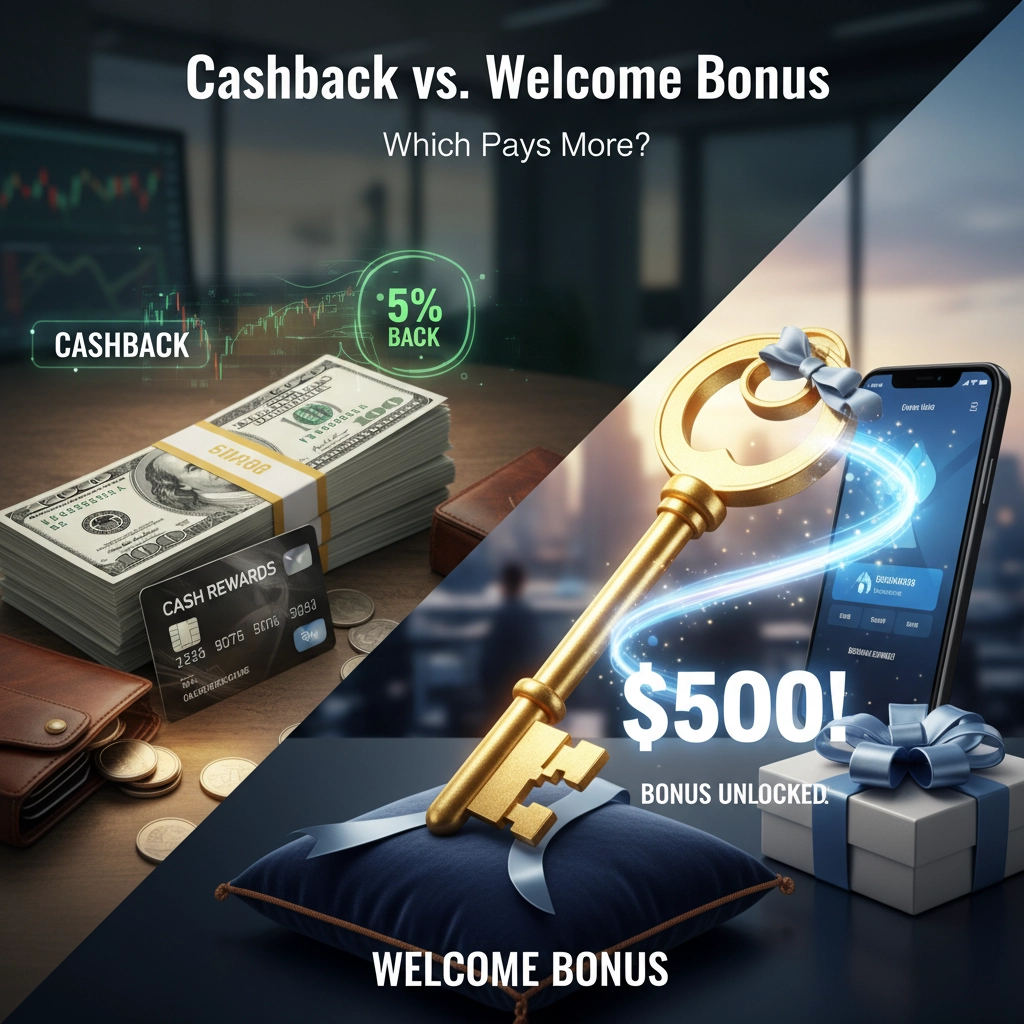
Why understanding cashback and welcome bonuses matters for your finances
You probably encounter offers promising “cashback” or a generous “welcome bonus” every time you shop, open a new account, or sign up for a service. On the surface both sound like free money, but they operate very differently and deliver value to different kinds of spenders. Learning the mechanics and typical trade-offs helps you choose the option that actually increases your net savings instead of just creating complexity.
In this part you’ll get a clear picture of how each reward type works, the common restrictions tied to them, and the baseline math for comparing offers. That foundation makes it easier to judge specific deals you see in the wild and avoid offers that look good but don’t pay off for your situation.
How cashback programs usually work and where value comes from
Cashback rewards return a percentage of your qualified spending back to you—either as statement credits, direct deposits, or points that convert to cash. The simplicity is the main appeal: if a card or program advertises 2% cashback, you expect roughly $2 returned for every $100 spent in eligible categories.
- Flat-rate cashback gives the same percentage on all purchases (e.g., 1.5%–2% everywhere). This is easiest to calculate and predictable.
- Category-based cashback offers higher rates in specific categories (e.g., 5% on groceries, 3% on gas) but may rotate quarterly or require enrollment.
- Tiered or bonus categories can increase returns for chosen merchants or spending caps, but often include caps or expiration windows that reduce effective value.
- Redemption options determine real value—cashback as statement credit is straightforward, while point conversions or gift card rates can lower effective cash value.
To decide how much cashback will really pay you, estimate your annual qualifying spend, apply the advertised rates or averages for your spending mix, then subtract any fees or redemption losses. That simple calculation shows you the effective annual percentage return on your spending from cashback.
What welcome bonuses typically offer and the trade-offs involved
Welcome bonuses are lump-sum rewards given when you meet a sign-up requirement—commonly a minimum spending threshold within a set timeframe (for example, spend $3,000 in three months to earn $500). They can be very lucrative up front, but their true value depends on how achievable the requirement is and whether you’d have made those purchases anyway.
- Bonuses often come with high short-term value but may not repeat annually.
- Meeting the threshold can require timing large purchases or increasing spending temporarily.
- Annual fees or behavioral incentives after the bonus period can reduce long-term benefit.
With these mechanisms in mind, you’re ready to quantify each offer for your spending pattern and spot common pitfalls that hide lower returns than advertised. Next, you’ll learn a step-by-step method to calculate and compare the real dollar value of a cashback program versus a welcome bonus, including worked examples you can adapt to your own numbers.
How to calculate and real‑world compare cash value
Start by converting both rewards into the same unit: net dollars per dollar spent (an effective return percentage) over a comparable period (usually one year). Use this step‑by‑step approach.
1. Estimate your annual eligible spend. Break it into the portion that will count toward a welcome bonus threshold (if you plan to meet one) and the remaining ongoing spend.
2. For a cashback program, compute: effective cashback % = (sum of category rates × share of spend in each category) − redemption/transfer losses − fees (annual fee divided by annual spend). That yields an approximate annualized return.
3. For a welcome bonus, compute the direct bonus return for the qualifying period: bonus return = bonus dollars ÷ required spend (e.g., $500 ÷ $3,000 = 16.7%). Then annualize it by spreading that bonus over your expected annual spend if you treat it as a one‑time benefit: annualized bonus % = bonus dollars ÷ annual spend. Add the ongoing cashback or rewards you’ll earn after the bonus (minus fees).
4. Adjust both sides for realistic frictions: redemptions that reduce value, any spend you wouldn’t have made (opportunity cost), interest you’d pay if you carry a balance, and any early annual fee that offsets value in year one.
5. Compare the two resulting annualized percentages and — more usefully — compare the absolute dollars you’d receive in a year under each option. Dollars are less abstract than percentages and make decisions clearer.
6. Run a sensitivity check: change key inputs (annual spend, how much of spend counts toward the bonus, whether you’d overspend) to see how robust the winner is.
This method keeps the comparison apples‑to‑apples and exposes when a flashy headline rate is only a short‑lived bump.
Worked examples you can adapt
Example A — Occasional spender (annual eligible spend $8,000):
– Cashback card: flat 1.5% → $120/year. No fee.
– Welcome offer: $300 after $2,000 in 3 months + 1.5% ongoing. If you easily hit $2,000, immediate bonus = $300; annualized bonus % = $300 ÷ $8,000 = 3.75%. Add ongoing cashback on remaining $6,000 = $90. Total first‑year value = $390 → effective 4.9%. Winner: welcome bonus by a comfortable margin, assuming you’d have spent the $2,000 anyway.
Example B — Moderate spender (annual eligible spend $30,000):
– Cashback card: 2% flat → $600/year.
– Welcome offer: $750 after $4,000 in 3 months + 1% ongoing, $95 annual fee. Bonus annualized = $750 ÷ $30,000 = 2.5%. Ongoing on rest = assume 1% of $26,000 = $260. Subtract fee: −$95. Total = $915 → effective 3.05%. Winner: flat 2% cashback card yields $600, so the welcome card still wins here, but margin depends on fee and whether you’d hit the threshold without extra spending.
Example C — Big spender with rotating categories ($75,000): rotating 5% categories but caps limit benefit. Often the steady 2% card or a portfolio of cards that cover top categories beats a one‑time bonus because the recurring scaled returns compound over many years. Run the same dollar math for your exact category mix.
These examples illustrate that bonuses often beat cashback for low‑to‑mid spenders in year one, but long‑term value depends on fees, your spending mix, and whether you’d repeatedly earn similar bonuses.
Hidden costs and behavioral factors that shift the balance
Beyond math, consider these real effects: churn and new‑account limits (you may not get repeat bonuses), credit‑score impacts, temptation to overspend to meet thresholds, and timing mismatches (a bonus that forces all your grocery spending to one card may conflict with where you already have the best return). Also account for expirations, enrollment requirements for rotating categories, and the hassle cost of managing multiple accounts. When those behavioral and administrative frictions are high, simple steady cashback can be the superior, lower‑stress choice even if the headline numbers look similar.
Final considerations before you choose
Deciding between cashback and a welcome bonus comes down to your habit, horizon, and tolerance for complexity. If you value simplicity and steady returns with minimal fuss, a flat cashback card usually wins long term; if you can meet a spending threshold without overspending and don’t mind managing accounts, a generous welcome bonus can deliver a meaningful first‑year uplift. Run the apples‑to‑apples math from earlier, account for fees and behavioral frictions, and if you’d like a neutral primer on credit‑card basics consult the Consumer Financial Protection Bureau on credit cards before you apply.
Frequently Asked Questions
Will applying for a card with a welcome bonus hurt my credit score?
A new application triggers a hard inquiry that can lower your score slightly for a short period; opening a new account also changes your average account age and available credit, which can affect score components. If you manage accounts responsibly—pay on time and keep balances low—the long‑term impact is typically small and can be offset by the benefits you gain.
How often can I earn welcome bonuses from the same issuer?
Many issuers impose limits—some allow one bonus per product lifetime or per X years (e.g., 48 months). Terms vary by bank and by card product, so check the card’s welcome‑offer language and the issuer’s rules before relying on repeat bonuses as part of your strategy.
If I carry a balance, does cashback or a welcome bonus still make sense?
Carrying a balance usually negates the benefit of rewards: interest charges commonly exceed the value of cashback or a one‑time bonus. If you expect to carry a balance, prioritize a lower interest rate and a simple card with no fees rather than chasing rewards that will be wiped out by finance charges.